AI drafts need receipts, not just better prompts
A practical implementation walkthrough for attaching bounded sources, validated references, version lineage, and human review to AI-generated drafts.

Published October 22, 2026 · America/Chicago
An AI-generated script can sound ready before anyone has checked what it is based on. For a business, that creates a practical review problem: the person approving the work has to reconstruct the research, separate observations from predictions, and work out whether the draft still reflects the brief they approved.
“Add citations” is a useful instruction. It is not a complete control.
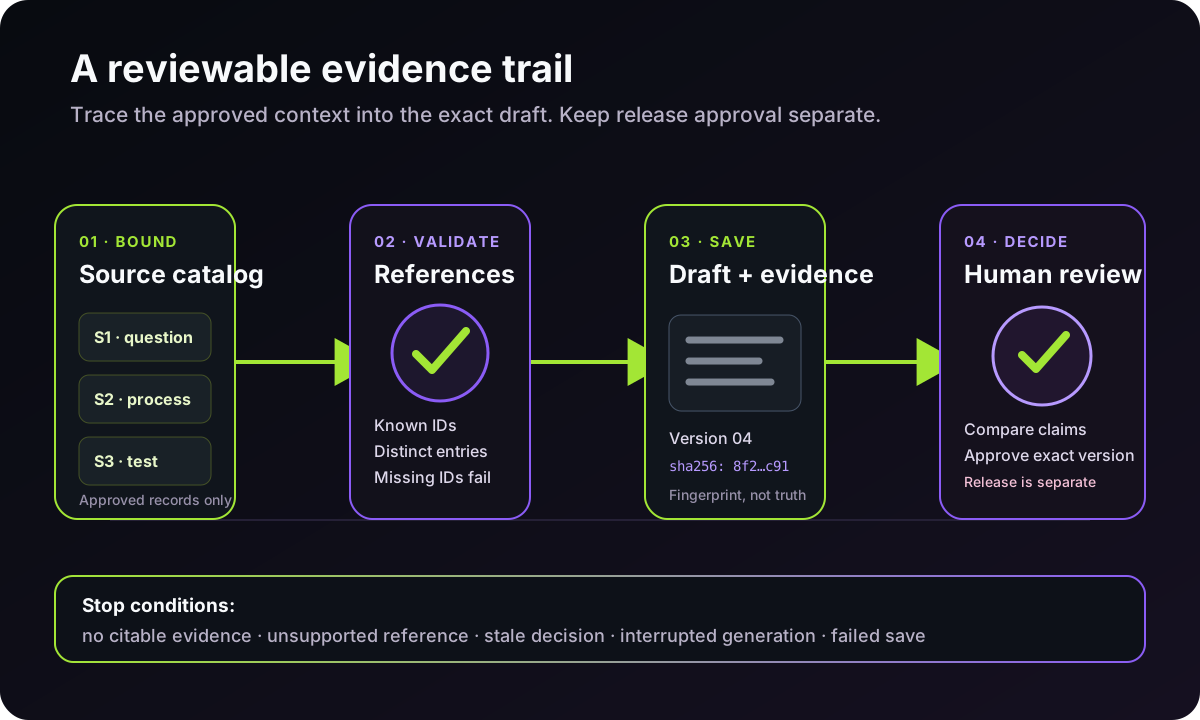
The stronger approach is to give the model a bounded set of source references, validate the references it returns, and save the evidence alongside the exact draft. Keep the decision to publish separate.
Cyber City Media has implemented that pattern in its Creative text-generation code. This is an implementation walkthrough, not a customer-results case study. It does not establish revenue gains, time savings, or a completed live customer workflow. The useful lesson is narrower: how to make a generated draft inspectable before it becomes business communication.
Start with the decision, not an empty prompt
Imagine an agency preparing a short video about a service. The team has a research report, a proposed angle, and a reviewer who has agreed that the angle is worth exploring. That agreement should not disappear when someone clicks Generate.
In CCM's implementation, the creative project carries the report identifier and version, plus the decision identifier, version, and hash. Before a new generation proceeds, the server checks those references against the current approved context. A stale decision is a reason to stop, not permission to improvise.
The draft should say which decision it is implementing and which evidence that decision used.
You can start without custom software. Add these fields to a brief:
- The business question this piece addresses.
- The source packet and its review date.
- The proposed message and its limitations.
- The person responsible for approval.
- What change would require a fresh review.
For example, a change in the service being promoted should trigger a review of the angle, not just an automatic rewrite of the final sentence.
Give the model references it can use—not provenance it can invent
CCM's code creates a source catalog on the server. Each entry has a short reference, a label, a URL, and an observation. The model returns reference identifiers from that catalog rather than inventing a new source list.
The distinction matters. A model-written URL is an assertion about a source. A server-resolved reference points back to a record the application actually supplied.
The current validator accepts one to eight distinct references from the supplied catalog. Missing references, duplicate references, and identifiers that are not in the catalog fail validation. Accepted references are resolved back to the server's labels, URLs, and observations before the draft is saved.
That is a traceability check, not a truth machine. A real source can still be irrelevant, outdated, incomplete, or misinterpreted. A draft can cite a valid reference and make a claim the reference does not support. A reviewer still needs to compare the words with the evidence.
For a small team, a source table can serve the same editorial purpose:
- S1 — Supports: a recorded customer question, used with permission. Does not establish: that all customers have this problem.
- S2 — Supports: a documented step in the delivery process. Does not establish: a measured time saving.
- S3 — Supports: an observed result from a defined test. Does not establish: a guaranteed result for a different business.
These are illustrative categories, not CCM customer evidence. Replace them with records you are authorized to use. Do not put customer identifiers or confidential material into a model merely because it would make the draft easier to write.
Preserve uncertainty inside the handoff
The Creative context includes more than a recommended action. It carries the expected range, confidence, downside, dependencies, and conditions for reconsidering the decision.
Those fields help preserve the difference between “we observed this,” “we infer this,” and “we propose testing this.” They should remain visible to the person reviewing the work.
Consider a proposed webinar topic. Interest in related videos may justify a topic experiment. It does not establish that the webinar will generate qualified leads. The content can explain the experiment and its reasoning without turning an attention signal into a sales result.
When reviewing a draft, mark every outcome statement. Ask whether it describes an observation, a forecast, or a promise. If the evidence only supports a forecast, rewrite the sentence accordingly.
Save the draft and evidence as one reviewable record
In the CCM implementation, a generated package contains a hook, script, shot plan, caption, call to action, and guardrail notes. The validator appends the resolved evidence to that package. The saved text receives a SHA-256 hash, and the generation record retains its project and source lineage.
A hash is a fingerprint of content. It helps identify whether two records contain the same bytes; it does not certify accuracy or confer approval.
The business purpose is version discipline. “I reviewed the draft” is ambiguous if the draft changed afterward. “I reviewed this version, with these sources” is much more useful.
A spreadsheet or document workflow can approximate this without cryptographic machinery: save a numbered, read-only review copy, attach the source table, record the reviewer, and create a new revision when the copy changes. Do not silently replace the approved version.
Treat failed attempts as failed attempts
The failure path deserves as much attention as the happy path.
CCM's code refuses generation when there is no citable evidence catalog. If the model returns unsupported reference identifiers, the output is rejected. The server attempts to record the failure and reports completion as unconfirmed if that write fails. Reusing a request identifier with different inputs produces a conflict instead of quietly replacing the earlier request.
Those are useful controls to test in any AI implementation:
- 1. Remove all sources. Does the workflow stop?
- 2. Return a source identifier that was never supplied. Does validation reject it?
- 3. Change the approved context. Can an old request still pass as current?
- 4. Interrupt generation. Does the interface show an honest incomplete or failed state?
- 5. Fail the save step. Does the system avoid reporting success?
Use synthetic material in a test environment. The point is to discover how the system fails before real content depends on it—not to manufacture production activity for a demonstration.
Know what the evidence actually proves
These controls are implemented in CCM's code; that is not proof of a completed customer workflow or business results. Measure those separately rather than treating an implementation milestone as evidence of leads or hours saved.
Measure business value separately. For a limited pilot, record review time, correction types, rejected drafts, and the eventual publication decision. Compare equivalent work, account for source preparation and human review, and avoid attributing every downstream result to the model.
Budget for the work around the model
The costs are not limited to generation. Someone must prepare usable sources, maintain the source catalog, review claims, resolve failures, and keep approval rules current. More checking can increase the effort required for each draft. That is a tradeoff to measure, not hide.
A bounded catalog also leaves material out. It makes the handoff easier to inspect, but it can miss relevant context. Include a clear way for a reviewer to request additional research rather than encouraging the model to fill gaps confidently.
Start with one repeatable content type and one reviewer. Keep publishing manual while you learn which errors the checks catch and which still need editorial judgment. Expand the workflow only after the evidence supports doing so.
A draft is not a publication receipt
Evidence attached to generated text does not establish image rights, proof approval, rendered media, successful distribution, or live publication. Those are separate decisions and events.
Before release, check the actual asset, its claims, permissions, destination, and final presentation. After release, verify the live result rather than treating a saved draft or a successful job status as proof that an audience can see it.
If you want to turn expert knowledge into a repeatable content-production process, start with a piece you already need to make: a podcast episode, webinar, interview, or short-form series. Map the source material, the review decision, and the production handoff before choosing more automation.
Explore Cyber City Media's production services for recording, editing, clips, and distribution, and bring that workflow to the conversation. The first useful question is not “How much can AI write?” It is “What will let us trust the next piece enough to release it?”
Bring the source material, review decision, and production handoff you want to make repeatable.